
Gareth Lloyd: Echoes of the Sacred in the Age of the Image
by Yulia (Hyun Ji) Kim
In a cavernous, dimly lit hall – once perhaps an industrial warehouse, now hushed like a deserted temple – a solitary figure looms into view. In these spaces where time feels suspended – eerie, abandoned, and often surreal – the worn, abraded walls draw the viewer into a liminal threshold. Within these haunting environments, Gareth Lloyd’s monumental paintings dominate the space, enveloping the viewer through their sheer scale and presence.
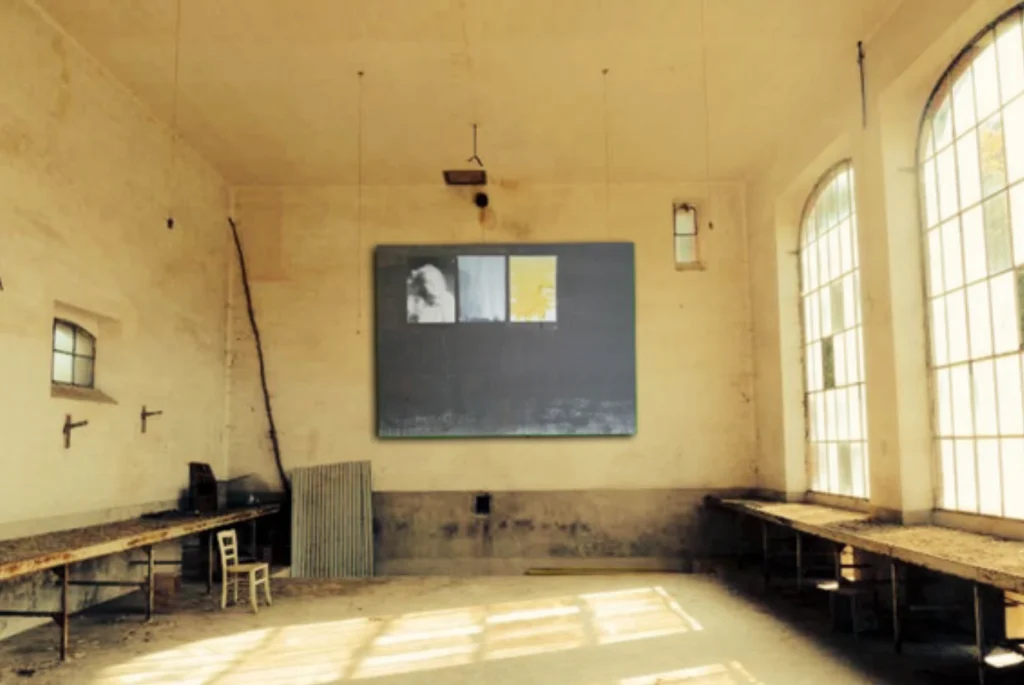
Dreaming Milk and Honey
Gareth Lloyd’s work unfolds across multiple layers – of image, colour, and surface – inviting us to witness the emergence of new figures and the latent possibilities that arise at their intersections. As seen in Fleeting Star, these points of convergence sometimes focus our gaze, while at other times they fragment attention across distinct forms. A blurred figure layered over a field of red becomes both a point of intensity and of dissolution, prompting the viewer to sense – or even project – a new image within the space where visual elements collide. In this way, Gareth Lloyd’s paintings encourage a kind of sensory thinking: a meditation on what emerges through the act of seeing itself.
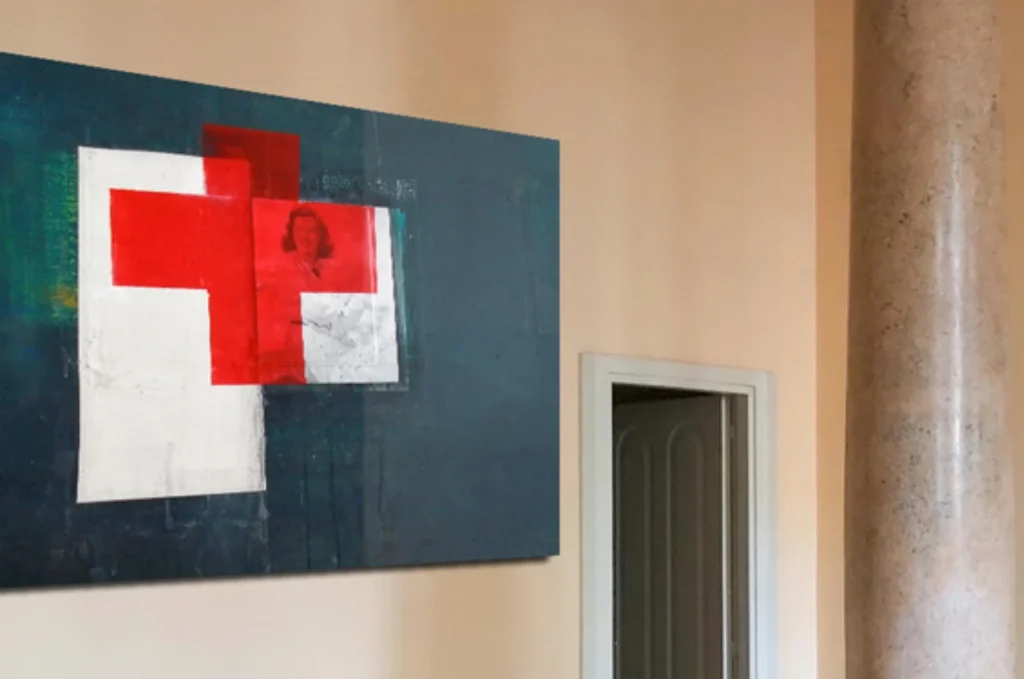
Fleeting Star
More than a rejection of digital saturation, Gareth Lloyd offers a form of secular spirituality through art. He rejects the clamour of technological novelty and the facile consumption of endlessly reproduced images, advocating instead for a return to authentic experience – art that must be encountered in person, in real space and real time. As one critic observed, Gareth Lloyd’s paintings and installations “make one inescapable demand: that the viewer be in their presence”¹, for only through direct engagement can their “active tension” and aura be truly felt. This insistence on presence becomes, in itself, a spiritual gesture within the context of contemporary art. It calls for faith in the here and now, in the unmediated moment of perception. Standing within one of those emptied-out halls with Gareth Lloyd’s work, a viewer might indeed feel something akin to being in a chapel or shrine. There is a hush, a reverent silence. And as the eye adjusts and the mind engages, transformation occurs: the abandoned warehouse becomes a site of mythic possibility; the artwork, more than pigment or form, becomes a threshold to deeper reflection.
At the heart of Gareth Lloyd’s practice lies a profound engagement with spiritual and mythological imagery. He consciously turns away from dominant trends in new media art, drawing instead from ancient symbols and enduring human narratives. While many artists pursue virtual or augmented realities, Gareth Lloyd returns to the concrete and the sacred: Egyptian gods and Buddhist sages. One emblematic piece features an Egyptian god crowned with a lotus blossom – a symbol of rebirth in Egyptian myth and enlightenment in Buddhist thought. Here, the lotus replaces the deity’s head, implying a synthesis of Eastern and Western spiritual iconography. This hybrid image suggests that beneath the diversity of myths lies a shared aspiration toward renewal and transcendence.
This shared aspiration toward transcendence, however, is never presented in isolation. Gareth Lloyd sets these spiritual and mythological motifs in dynamic tension with the visual language of contemporary popular culture. In doing so, he avoids romanticising the sacred past and instead interrogates how such symbols function within today’s image-saturated world. In today’s ever-expanding ‘Desert of the Real’, Gareth Lloyd’s work resists mediation. It demands presence – an encounter with the original, rather than its endless reproductions. In Points and Lines in the Age of Terror, for instance, he stages a provocative dialogue between mythological archetypes and pop culture’s cartoon icons. Sacred figures like the sphinx are juxtaposed with Disney-like characters. This strange pairing unsettles familiar associations: ancient symbols lose their sanctity, taking on a childlike air, while cartoon forms grow uncanny and ominous. Mischievous play meets innocence, just as menace shadows mystery, allowing contradictory meanings to emerge.
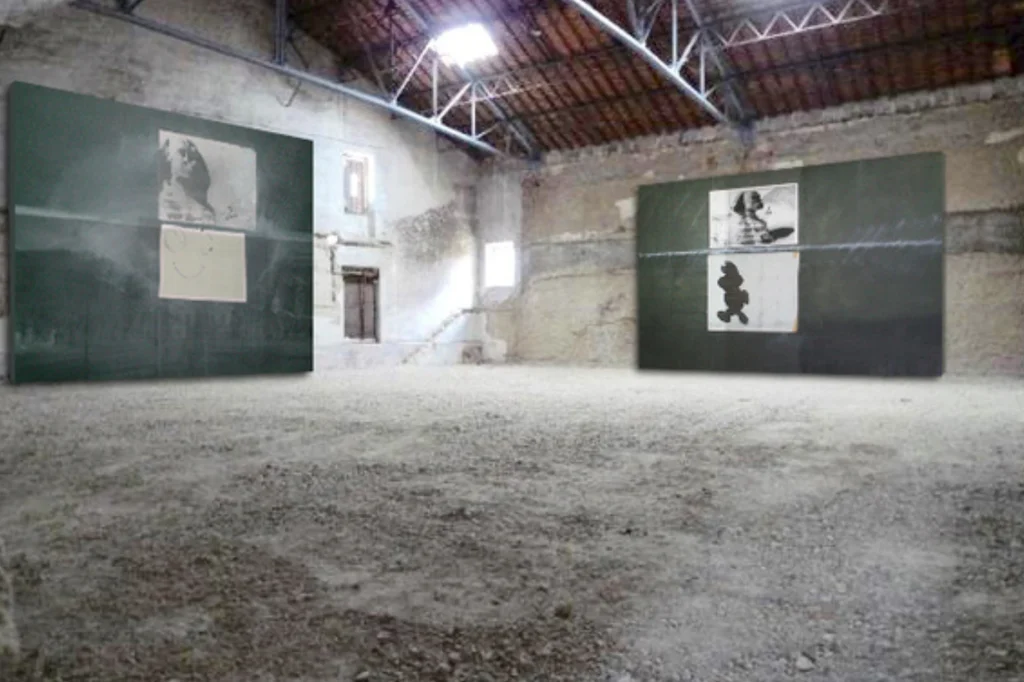
Points and Lines in the Age of Terror
In this paradoxical zone of collision, Gareth Lloyd resists clarity not by destroying symbols, but by holding them in suspension. His compositions refuse tidy resolution, allowing contradictions – sacred and profane, innocent and sinister – to remain in flux. This strategy opens a space not for fixed meanings, but for speculation: a visual field where icons are loosened from doctrine, and viewers are invited to think, not consume. Far from repeating symbolic clichés, Gareth Lloyd plays with them, de-doxifying inherited myths and cultivating what might be called an aesthetics of dissent.
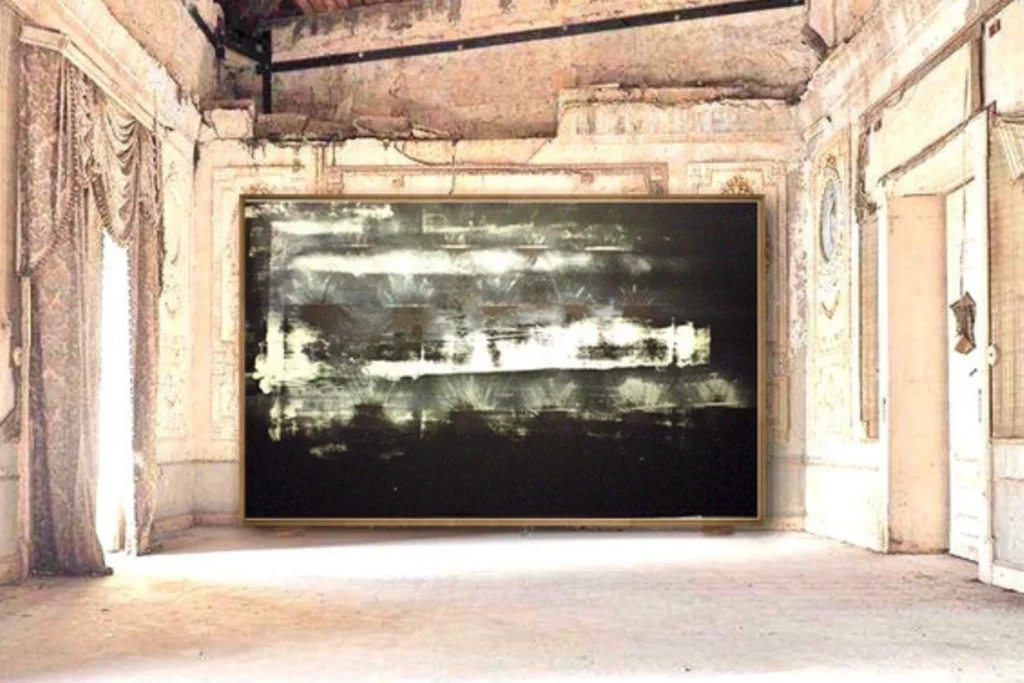
Light/Shadow on Liangshan Margin
If the spiritual dimension is one pillar of Gareth Lloyd’s art, the other is the physical space in which it is encountered. Gareth Lloyd is drawn to exhibition sites imbued with their own histories – vast, worn, and seemingly abandoned settings that stand in stark contrast to the sterile white cubes of contemporary galleries. Stepping into one of his installations, the viewer might find themselves inside an old factory, a dust-laden loft, or the overgrown grounds of a remote monastery. These are not passive backdrops but charged environments – echo chambers in which themes of transience and myth reverberate. In a sun-scorched hall with a collapsed roof, a lotus-headed Egyptian god rises like an unearthed relic; the surrounding emptiness speaks of erosion, memory, and the passage of time. Elsewhere, two faded canvases face each other across a barren floor, invoking a hush that feels devotional rather than desolate. These “forgotten halls” carry a silence that borders on the musical – the echo of footsteps, the drip of water, the breath of wind through broken glass – pulling the viewer into a slower rhythm. In such spaces, time loosens its grip, and the body reawakens to the act of seeing.
Gareth Lloyd’s work is a journey through shadow and light, form and formlessness – set in spaces that amplify its philosophical and emotional resonance. It speaks to everyone, operating on multiple levels: visually arresting, yet conceptually and spiritually rich for those willing to engage deeply. In his vast installations, we encounter the weight of history and the whisper of the sacred; in his delicate figures, the mythologies of our era refracted through time. Gareth Lloyd invites us to experience these environments not only with our eyes, but with our full selves – bringing memory, belief, and imagination to bear. The experience is both critical, in how it questions contemporary visual norms, and poetic, in its evocation of the timeless. As one exits the gallery or warehouse where his work is shown, stepping from silence into the noise of the everyday, a sensation lingers: that of having visited a place out of time. One feels as though they have walked among ruins and idols in some forsaken hall of faith – and, in that passage, touched the elusive continuum between past and present, matter and spirit. In Gareth Lloyd’s art, the material and the metaphysical converge, offering us not only a reflection on the image, but a sanctuary of meaning.
References
¹ Ryan, Paul. Some thoughts on the paintings of Gareth Lloyd. [Officier de l’Ordre des Arts et des Lettres].
Author Bio: Yulia (Hyun Ji) Kim, University College London
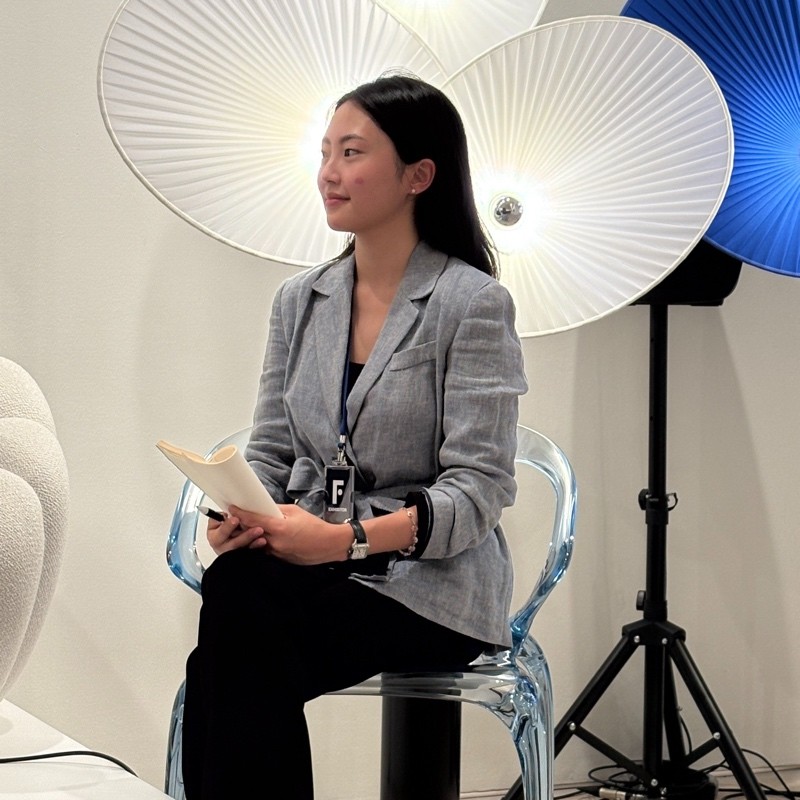
Yulia (Hyun Ji) Kim is a researcher working across modern and contemporary art, with a focus on visual culture, gender, and ritual.
She holds an MA in History of Art from University College London, where her research centred on female artists associated with Surrealism, examining their use of myth, costume, and performance as strategies of self-fashioning and resistance. Her recent work explores the intersections of material culture, cultural theology, and esoteric traditions in visual art. Holding a prior MFA from the Ruskin School of Art, University of Oxford, she combines theoretical inquiry with practice-based perspectives, shaped by an ongoing interest in the political and symbolic dimensions of image-making.
To view the other essays about Gareth Lloyd’s work by Shahidha Bari, Paul Ryan, Jeremy Reed as well as other updates from FEIN Collections in Bruton please visit our News section.
